Showing posts with label Mentor. Show all posts

Thursday, December 6, 2012

PASTORAL REFLECTIONS ON THE PASSING OF MINISTER ALOYSIA INYUMBA


I woke this morning to startling news from a friend in Rwanda.   Honorable Minister of Gender and Family Promotion, Aloysia Inyumba has passed from this life to another.    She leaves behind a husband and two children.    Our region’s newspapers quickly began coverage of a remarkable woman.     Social media told the more personal details.   It is astounding to quickly observe on Twitter and Facebook how the titles we gave her moved from “Honorable Minister” to “Mother,”  “Auntie,” “Mentor,” and “Friend.”     She was a woman who quickly could bring us into places of great warmth and hospitality.     In the end she believed in many of us more than we believed in ourselves.     I wonder if there are any in Rwanda who have not in some way been touched by Minister Inyumba.    Many of our best efforts and accomplishments were nurtured by her faith in God moving through the people of Rwanda.

As with the transitions that come to those who in the eyes of humanity seem “too young” our hearts grief.    How does one explain the loss of a mother to children?   And who amongst us does not consider her to be one of our aunties?

We return to the oldest stories of mankind’s sojourn with God.   Israel’s Shepherd King, David wrote by the inspiration of the Holy Spirit in Psalm 23 (New King James Version):

“The Lord is my shepherd;
I shall not want.
 He makes me to lie down in green pastures;

He leads me beside the still waters.
 He restores my soul;
He leads me in the paths of righteousness
For His name’s sake.
Yea, though I walk through the valley of the shadow of death,
I will fear no evil;
For You are with me;
Your rod and Your staff, they comfort me.
You prepare a table before me in the presence of my enemies;
You anoint my head with oil;
My cup runs over.
Surely goodness and mercy shall follow me
All the days of my life;
And I will dwell in the house of the Lord
Forever.”

As David reflected on the loss of his own son, he said, I will go to him, but he will not return to me (2 Samuel 12:23, New International Version.)”

By the inspiration of the Holy Spirit Job 19:25, 26 tells us, 

“I know that my redeemer lives,
    and that in the end he will stand on the earth.
And after my skin has been destroyed,
    yet in my flesh I will see God.”

Jesus Christ was God in the flesh among men.   He showed us the heart of the Father.   When His friend Lazarus had passed from this life two simple words tell us all, “Jesus wept (John 11:35.)”   In the midst of our overwhelming loss God himself is in our midst providing hope and comfort.   Then Jesus raises Lazarus from the dead.    

Within a week of Lazarus resurrection, Jesus himself is brutally killed and then rises from the dead.

Our grief and loss is real.   Yet, our hope in a final Resurrection where all will return to God’s intent is the final reality for which we hunger.

As we grief in hope it is appropriate to remember the enduring characteristics of Minister Inyumba.    
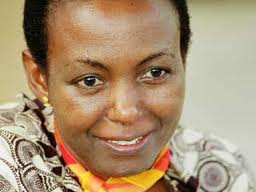
We quickly remember her humility.   As she rose to places of influence she still listened.   She had time to ask questions.   In between hurried meetings she was available.    

In those humble meetings her questions moved to wise guidance.   She could master complexities with grace.  Then find a way forward.   

We know her tireless work ethics.   This was driven by her deep compassion for women and children.    Her compassion spurred on her incredible courage.   
The place Minister Inyumba occupies in our hearts can never be replaced.   Yet by the grace of our Lord the loss and grief we now feel will heal.     After all, Minister Inyumba believed in the hope of our common future.   This hope cannot be contained by a created body of flesh and blood.

The dialogue I read and heard today was one of memories.  I noticed three enduring legacies of Minister Inyumba.

The first was her faithfulness.    Her name follows the history of her people.   She is found in a multiple of historic roles.   In each role that was given her she was faithful.   We were blessed.    I can say with great confidence yesterday, she was met by the Lord with the words, “Well done, good and faithful servant (Matthew 25:21, 23; Luke 19:17.)”

The second enduring legacy was her advocacy for women.   She healed our wounds.   She served widows.   She mentored ceaselessly.    She elevated the status of women by her profound moral authority.    I observed that her very presence caused us to stop, reflect, and change.   Her voice spoke with consistent faithfulness.    Her belief in women’s dignity reflected her faith in God who made all humanity in God’s image.   She saw that God had created women with unique gifts that must be nurtured.   Her advocacy brought us peace and healing.

The last legacy was her compassion for Rwanda’s children.   Her compassion was the authentic compassion of the Lord.   It moved from deep within her being.  It was full of the passion of humanity.   Then it sprang forth in behavior that simply got things done.    

One her most enduring quotes is "We're committed to seeing all Rwanda's children grow up in loving, caring families and not in institutions"

A friend today called her a champion of Rwanda’s children.

Many of us have personal stories to tell of Minister Inyumba.

My family shared a similar conviction with Minister Inyumba that every child has a right to a family.    I once had a 10 minute conversation with Minister Inyumba that I could never forget.   She made time for me in busy day in which she was meeting many important people.   We spoke of the de-institutionalization of orphans and vulnerable children in Rwanda.  She let me see a bit of her humanity.   Why was she facing so much opposition?   Why were there so many untruthful and unjust accusations?    

I shared the nature of institutions.   They are self-protective.   It is their nature.   Governments protect their tax payers.   Churches protect their members.   Schools protect their students.   Businesses protect their customers.    This is good.   In fact such institutions will endure with generations of good fruit.   

However, sometimes an institution arises that in its self-protection loses sight of the common good.   Orphanages easily become these types of institutions.   In order to appeal to donors they must have children.  Keeping children in institutions is necessary for their survival.

I apologized.   My race, nation, and Balokole clan mates have been some of the worst offenders in institutionalizing vulnerable children.

I shared a conviction that took the Lord working on me for 18 years.   The most Biblical way to approach the care of vulnerable children is adoption.   In fact, adoption is a metaphor of the Gospel.  Churches that don’t teach and live adoption are negotiating the Good News of Jesus.

I shared a hope that Rwanda’s churches and families would arise to meet the challenge.   It was my hope that whenever a child fell into a vulnerable situation a network of families would be prepared by churches to immediately take that child into their home as a foster child.   Hopefully, the child would be reunited with his extended family.   However, if that did not happen then that child should be adopted and have the full legal and relationship rights of a biological child.

Minister Inyumba looked directly into my eyes, accepted my apologies, and then said, “Pastor that is exactly what I hope also.”

Gabriel Mugisha Jacobs with the nurses who cared for him in Rwamagana
God never allows leaders to simply make proposals and write policy.   We must practice what we preach.   A few months later, my foster son Gabriel Mugisha Jacobs was having 3 clusters of seizures per day.   We had spent 2 weeks at King Faisal Hospital.  It was time to go to Nairobi.   MIGEPROF and emigration quickly got us the required travel documents.    Our family was broke.   Then God’s providence happened.  Friends in Kenya, Uganda, America, and Rwanda rallied.   Minister Inyumba was one of the friends who placed a little money in our pockets for Mugisha.   Her contribution was one of those first fruits from which God begin doing the astounding.     Mugisha has now not had a seizure in 11 months and is loved by a forever family.   I’m confident Minister Inyumba’s acts of faith are one of the reasons Mugisha is well.

A year ago a friend of mine, Major Eustache Nsinga passed from this life.    I had the profound responsibility to perform his funeral.   In it I summarized his life as being irreplaceable.   I believe all of us are created in God’s image and with God’s eternal purpose given unique gifts.   Thus each of us is irreplaceable.   

My sermon was followed by a speech by Rwanda’s Minister of Defense James Kabarebe who had the courage to point out a hole in my sermon.   We are all in an army for God.   When a soldier falls he must be replaced.  Without replacements our endeavors on this earth are doomed.   He was right.
God’s Word fills us with the wisdom of paradox.  Each of us is irreplaceable.   Yet, each of us must eventually be replaced.

As Minister Inyumba is now resting as a rewarded faithful servant it is our task to continue her legacy.

Who will be faithful in whatever roles one is given?

Who will advance the dignity of women?

Who will take vulnerable children into their families to adopt and raise with the full legal and relationship rights as biological children?

Minister Inyumba’s passing should cause us to like the men and women of old raise our hands and say, “Lord, here am I.  Send me.”

Monday, December 3, 2012

NEW START PRAYERS

Dear prayerful friends and family,


One of our convictions is that we live in the Acts 29 season of eternity.   Acts 28 closes with an awkward ending.   Paul is under Roman house arrest preaching the Gospel.   What happens next?  Is he released?   What fruit is born from his preaching?   We can conjecture from Paul’s letters, but we think the Holy Spirit leaves us with a clear point.   There will be seasons of mystery.   The task is unfinished.   Thus we pray.   Thus we preach.   Thus we wait in hope.


During this season in which we answered a call of God to return to the United States to serve the Diaspora of Africa’s Great Lakes we have repeatedly read Luke and Acts.   (For review of who are the Diaspora see http://jenkinsinrwanda.blogspot.com/2012/11/pray-for-diaspora-of-africas-great-lakes.html.)   In this reading we find great similarity to our entering of Chicago, and Paul entering Corinth (Acts 18.)  

Our community is convinced we have been called to another continent just as Paul’s team was convinced of the Macedonian Call in Acts 16.


Yet, like Paul our financial support is declining and we are practically without a team of colleagues and friends in close proximity (Acts 18 – Paul in Corinth.)   

However, we sense just like Paul the Lord is speaking to us in Chicago,

“Do not be afraid, but keep on speaking and do not give up, for I am with you. No one will be able to harm you, for many in this city are my people.” (Acts 18:9-10. Good News Translation.)”

This month we request you pray as Paul’s team likely prayed for him as he entered Corinth:

1.  Pray that we’ll find new friends like Aquila and Priscilla:  Those with whom we share a similar cultural and faith understanding.  Those with whom we can find a common way to make a living.   Those with whom we can mentor and nurture into a new ministry.

2.   Pray that like Paul we’ll be joined by those like Silas and Timothy who can lighten our load as the forming community needs us to teach and shepherd more.


3.   Pray that like Paul we’ll find good soil in the hearts of people such as Titius Justus and Crispus who can share living and leading with us.

Thank you for your prayers that sustain our family and ministry,

Mungu akubariki (God bless you),

Dave and Jana

P.S. For more reading on what life is like as missionary to the Diaspora of Africa’s Great Lakes in Chicago check out: http://jenkinsinrwanda.blogspot.com/2012/11/everything-i-needed-to-know-about.html.

P.S.S. For more reading on the shifts in contemporary missions discussions check out: http://jenkinsinrwanda.blogspot.com/2012/11/why-puzzle-in-contemporary-missions.html

Thursday, October 4, 2012

RWANDA: THE NATION OF 1,000 NARRATIVES, 4 DEFINING EVENTS, AND 1 GENERATIONAL TIPPING POINT


Catching up with missionary peer, Sam Gonzalez at ACU's Summit
                I have now been out of Rwanda for four months.   I don’t need to be tempered, moderate, nor politically correct.   This season will likely be short.   It is a season of prayer with the opportunity to be prophetically candid.   

                The twitter banter about Rwanda is almost a daily event.   About every two weeks some new expert weighs in.   It seems now is a season for me to speak.    What do I think of contemporary Rwanda?   Let me tell a story.

                During my last few days in Rwanda I had dinner with a member of the foreign diplomatic corp.   Both of us loved Rwanda dearly.   Both of us were nearing the end of our posting.   What did we think?    My friend used a phrase that resonated deeply.   He said, “Rwanda is a nation with 1,000 narratives.   You can assemble many narratives.   All can be true.   Many are contradictory.   Then you can draw the conclusion you want.”

                If we live in the world of shadows and rumors contradictory narratives are abundant.    Shadows are dangerous places and easy to manipulate.   Few of us can accurately know what happens in the world of shadows.    Yet, most of us get a moment where in our area of expertise light shines and we see full truth.

                An area I have seen up close and personal is university education and scholarship programs.   Allow me to construct two contradictory yet true narratives.   

Saying good bye to Presidential Scholar, Pie Fabio Ntagwabira

 I can document exceptional Rwandan university students.   Some come from privileged backgrounds yet many come from the poorest village.    They have succeeded under the most difficult of circumstances.     They come to school tired from poor sleeping conditions, hungry from lack of food, study long hours, volunteer any place they are needed, create ideas beyond their youth, start new businesses, and inspire me at every turn.  They refuse to see the world through the lens of race and ethnicity.   Words such as scholar and entrepreneur are fitting descriptions.   This is a true narrative that I can document.

I can also document rampant plagiarism and forged attendance lists.   I’ve caught students cheating on exams.     I’ve failed many (or at least told them to start over.)    When confronted I’ve been accused of prejudice due to race, ethnicity, heritage, and language preference.   I’ve heard rumors frequently of sexual favors and bribery schemes to get high marks.   A couple times I thought someone was trying to see what I’d trade for marks.   In problems they will choose the easiest possible route without considering the ethical implications.   Words such as conman and prostitute are fitting descriptions of some of these Rwandan students.   This is a true narrative that I can largely document, but you would need to trust me on matters where I did not have a witness.

One thousand true narratives exist in Rwanda.   The choice we face is which narratives are defining.   In every area of life in Rwanda you can find contradictory narratives.   Education, church, business, and government will all provide abundant contradictory narratives.   We can label individuals charlatans or shepherds; crooks or businesspeople; and leaders or thugs.   

Yet, I believe there are four defining narratives.


The first is Creation.    (I’ll avoid debates on science and evolution, and confine my discussion to the nature of man.)    We humans were created in the image of God.   We are full of agaciro not because of a government policy, but because of God’s proclamation.    We are all worthy of respect.   We are intelligent, gifted, creative, and compassionate.   We innately are born with a sense of justice, peace, and grace.   We can overcome any difficulty and forgive any wrong.    Dignity is our destiny.

The second defining narrative is the Fall.    Our dignity was sacrificed by our own choice.    We are totally depraved.     We are full of lust, greed, jealousy, and hate.    We destroy one another, ourselves, and creation.    We have all done things that we keep hidden from others.   Still, we are full of pride.     We are ashamed at who we are, what we have done, and what our future deserves.

The only way I can make sense of the contradiction of Rwandan university students who I can both describe as entrepreneurial scholars on one hand; and prostitutes and conmen on the other is through the defining events of the Creation and the Fall.   In fact, on any university (even Balokole ones) in North America and Europe I can find students with such contradictory narratives.    The contradictory Rwandan narratives are just part of the broad human story of history.   All humanity is full of both dignity and depravity.

The third defining narrative is the death, burial, and resurrection of Jesus of Nazareth.    The only way to deal with our human depravity was for someone to be punished.   In fact, the punishment for such grave offense had to be death.    The UN and human rights watchers could not restore dignity without one being brutalized.    Yet three days after Jesus’ brutal death, He overcame death.   His body came back to life.   He went to heaven to be with our Father, and sent His Holy Spirit to live in our hearts.   Only when we accept how depraved we are, but hunger for dignity, put our hope in Jesus’ resurrection, and have the Spirit of God living in us can we become full of the full human dignity God intends.

Yet, we don’t live in Utopia.   Followers of Jesus are still screw ups.    We wrestle every day with our contradictory dignity and depravity.    

Another day is coming that will make everything right.    The fourth defining narrative is Jesus’ return.    All will be judged.   We’ll be found guilty as charged, but then be totally forgiven.     All will be returned to God’s intent.   All will be right at that day.   There will be no sickness or death.   We will be filled with love and peace.

But, what about today?   We are still waiting for that final day.   We have yet to experience the fourth defining narrative.    Historians and pragmatists note that sometimes dignity overshadows depravity, and vice versa.

Maybe, the reason twitter is so busy debating Rwanda’s contemporary predicament is we live in a generational tipping point?    Intuitively, we all seem to know the actions of today’s generations in Rwanda will resonate for many generations that follow.    What will life be like for generations in Rwanda until Jesus returns?   The answer lies in how the scales are tipped from depravity to dignity.    

Two generations of Rwanda are essential.   There is a group that a few jokingly call, “Mzee kijana.  We landed well.   We may have excelled academically, worked hard, and gone through exceptional difficulties.  Yet, we know in the deepest places of our hearts others could do a better job.    We were able to lead because of grace.    We’re younger than our peers in neighboring nations who carry such prestige.   We’re in over our heads.    We work long hours.    The work never ends.    The institution has to be stronger than our charisma.   The temptation is to out of fear stake out our territory and defend it to the end.  

Instead, the mzee kijana has two tasks.   First, he must mentor.   Second, he must relinquish.    He must ask other to follow.   He must teach and model everything he knows.   He must correct with grace yet never leave a task undone.   He can tolerate no ethical compromises.   Then before it seems it is the appropriate time, he must relinquish.   He cannot build a personal kingdom.   

The twitter banter about Rwanda’s leaders until 2017 is just conjecture.   In 2017 we will know the character of Rwanda and her leaders.    Until then those of us labeled bzee must practice the paradoxical virtues of mentoring and relinquishing.    Coming generations of Rwandans leave us no other choice.   As bzee choose to embrace human dignity they mentor and relinquish.

Celebrating KIST 2012 Graduation with Ntabgoba Jovani  
The second generation of essential Rwandans can now be found in schools throughout Rwanda, universities in other nations, and are just now beginning their professional career.     Their task in the generational tipping point is to prepare themselves for leadership.     

There will be several temptations they will face.   For a fortunate few it is “spoiled brat syndrome.”   Their parents have landed well and are quite busy.   The spoiled brats squander their opportunities in academia by spending their evenings and weekends chasing the hottest party.    On the opposite economic spectrum are the “woe is me” syndrome kids.    Their parents have not economically landed well therefore the “woe is me” kids spend their time complaining and nurturing their “victim status.”  If they land well enough to get a twitter account they spend their creative energy complaining instead of building.   However, they share common pastimes with their peers on the other economic spectrum.    Both overdose on self absorbed leisure that does not build their bodies, minds, or spirits.   Both the “spoiled brat” and “woe is me” kids are incredibly dangerous for Rwanda’s future.   They represent the triumph of human depravity.

However, the Rwanda youth who I choose to make my defining narrative pursue human dignity with all the passion of youth.   They read everything they can find.    They get the most of each academic experience.   They come to class early and stay late to pick their professor’s brain.   They master several languages.   They make many friends.   They give of themselves at Umuganda, church, and every other situation they can find that offers them an opportunity to serve their community.    They work when they can find a job.   If they can’t find a job they start creating ones.   The really good ones take the role of mentor when they are still being mentored.   They teach at schools on their vacation, tutor younger siblings and neighbors, and treat knowledge as a treasure to be shared.   Their day to provide leadership is quickly coming.   Their time is spent in preparation.

So what do I think of contemporary Rwanda?   My diplomatic friend is right.   There are 1,000 narratives.    We choose the narrative that best fits our agenda.    My agenda is the dignity of man was part of God’s intention from Creation.   Our depravity at times triumphs.    However, Jesus’ resurrection restores us to God’s intention of dignity.   Now we’re at a generational tipping point.   The commentaries and twitter banter is premature.   The time now is for the bzee to mentor and relinquish.   The time now for the youth is to prepare.

Let’s leave today’s judgment to God’s future.