Two weeks ago, my friend and editor Shyaka Kanuma wrote a column, “Religion, always at odds with logic and reason”. He had the courage to write publicly what many of us think privately. His column has been widely read and commented upon. He had many valid points. However, I believe he overstated his arguments.
Let me start with definitions. One definition of religion is “a set of beliefs concerning the cause, nature, and purpose of the universe, especially when considered as the creation of a superhuman agency or agencies, usually involving devotional and ritual observances, and often containing a moral code governing the conduct of human affairs.” The definition makes religion the academic pursuit of understanding, devotion, and moral reasoning. The definition alone should tell us religion is one of our first human responses of logic and reason when we realize there is more to life than what we currently see.
It appears to me that what Shyaka discussed was not religion but fanaticism. The dictionary defines fanaticism as “wildly excessive or irrational devotion, dedication, or enthusiasm.” Fanaticism is always at odds with logic and reason.
Shyaka began with a quote from Christopher Hitchens, “Religion poisons everything.” Another of Hitchens’ memorable quotes is “The real axis of evil is Christianity, Judaism, and Islam.” Hitchens was obviously a courageous man and deep thinker. However, I wonder if he may have been as guilty of fanaticism as those he criticized.
I am a follower of Jesus of Nazareth. He told his followers “You are the salt of the earth. But if the salt loses its saltiness, how can it be made salty again? It is no longer good for anything, (Matthew 5:13.).” “It is fit neither for the soil nor for the manure pile; it is thrown out (Luke 14:35).” In shamba boy sheng He said, “If you choose to follow me you must add seasoning to life. If you don’t, you are not worth a pile of cow dung.” I thoroughly agree with Jesus. The hateful fanatics are the problem. Religion is answer.
Jesus repeated an ethical phrase his predecessor Moses spoke. “Love your neighbor as you love yourself (Leviticus 19:18, Mark 12:29-31).” The best religious and philosophic leaders have spoken this message for the history of humanity. I have neighbors who are pagans, Christians, Jews, Muslims, agnostics, and atheists. Though I disagree with all in some ways, I do like them all. I find all make me a better person. I have found I do best when I love my neighbors as I love myself.
I take particular offense when my Muslim, agnostic, and atheist friends are singled out as I know they can be an easy target. When one is unkind and unreasonable to them you may escape community critique. Shyaka referred to fanatical elements in the Muslim religion. Those fanatical elements do not represent my Muslim neighbors anymore than fanatical Christians represent my Christian neighbors. My Muslim neighbors have astounded me time after time with their generosity, integrity, and hospitality.
When my foster son, Mugisha Gabriel, was having 3 convulsions per day it was a Muslim doctor in Nairobi who found a drug cocktail to significantly reduce his convulsions. He did this because he practiced this old religious mantra, “Love your neighbor as you love yourself.”
Shyaka brought back an old argument, “Since God is so great why won’t they let him fight his own wars?” Exactly. An old Jewish teacher, Gamaliel led a mob to be gracious towards early Christians with the same argument (Acts 5:33-40). Let’s allow God to be God, and make final judgments. It is the fanatics who seek to become the final judge. The religious are content to patiently wait.
Where I think Shyaka most overstated his arguments is in his comparison of reason in the discovery of both religion and science. For instance he wrote, “Reason and religion however have never been on the same page. And I mean all religion. Logic (and scientific reasoning) persuade you with facts arrived at through painstaking research, empirical data, and knowledge gained through years of experimentation. Religion establishes itself through unverifiable stories of mythical happenings… God creating the universe in six days; Moses and the burning bush… Jesus feeding multitudes with a few loaves of bread and fish, and so endlessly on.”
Here’s how I read Genesis and Exodus. Moses was trying his best (and led by God) to explain to a pagan world – whose fanaticism practiced sacrificing children to idols and whose economic theories practiced slavery – that there was an unseen God which created the world and called us to the ideals of love. From the Creation account to the end of the Genealogy of the Nations (Genesis 1 to 11) you could call this type of literature “mythology” as you have no historical markers of which to tie the story. However, once you come to Genesis 12 and Abraham you have historical nations, cities, people, cultures, and languages. Then it is time to debate the interpretations of historical literature. If we label Genesis 12 to Revelation “mythology” we are not giving the debate an honest hearing.
No matter how you read history you eventually get to A.D. 33 and must deal with the claims of Jesus’ followers that He rose from the dead. I think the most reasonable evidence is that Jesus did rise from the dead. Paul told us there were 500 witnesses to the resurrection (1 Corinthians 15:6). History tells us that many of these died for this conviction. Why would so many die for a lie? I think the best evidence concludes they were transformed by a resurrected Jesus, and could never deny the experience.
Shyaka wrote, “Religion imposes itself through violence.” I disagree. Fanaticism imposes itself through violence. Historically, this includes pagans who sacrifice children, those who martyred early Christians, and churches that were complicit in Genocide and Holocaust.
Shyaka wrote, “Science widens our horizons and expands on our knowledge.” I agree. Without science a Muslim doctor would not have found a drug combination to treat Mugisha. Also, without science we would not realize how massive is the universe and how miniscule is humanity. Good science strengthens good religion.
When I was a young pastor, my Senior Pastor Royce Dickinson defended religion with reason. His last argument was, “I believe because I want to.” He had the courage to disclose his deepest desires. The only way we can make sense of the mysteries of love, hope, and joy is to believe there is something beyond what we can see. The only way we can also face today’s pain and confusion is to believe that another day is coming when all will be made right.Shyaka, you made us think better. Though I disagree with some of what you wrote, I thoroughly enjoy your friendship and discussion. Thank you. Fanaticism is always at odds with logic and reason.
Tuesday, March 13, 2012

Sunday, March 4, 2012
THE POLARIZING PERCEPTIONS OF RWANDA
When visitors to Rwanda have a moment of quiet candor one question frequently rises, “Why does Rwanda so polarize people?”

Dave Jenkins
Those who blog about Rwanda leave little middle ground. They tend to be either Rwanda haters or lovers. Media establishments from both our region and around the world are no different. They seem to either seek salvation through Rwanda’s leaders, or conclude that Rwanda’s leaders are diabolical schemers.
What if the reason Rwanda is so polarizing has something to do with the oldest natural inclinations of humanity? What if Rwanda exposes our failings, and in the process we polarize? What if in our desperation we seek either a hero to emulate or a villain to blame (and in the process avoid personal responsibility)? What if Rwanda’s contemporary voices are much like those of old called prophets (those with profound moral insight and exceptional powers of expression)?
Four old voices quickly come to mind – Daniel, Shadrach; Meshach, and Abednego. The first description of them were “young men without any physical defect, handsome, showing aptitude for every kind of learning, well informed, quick to understand, and qualified to serve…” They knew their mother tongue, but also the language and literature of the Babylonians. They received the best of the world’s education for three years. Whether in exile or in study they were 10 times more effective than the locals. Then they were entrusted with public civil service. Does this not sound like the both loved and hated Rwandese? Handsome, beautiful, intelligent, quick witted, multi-cultural, and well educated? Just those attributes alone will stir either esteem or jealousy.
When those attributes swing into action the results are polarizing. Our well managed technological world is still full of mystery. When we are so close to a situation that everything is comfortable we miss the ability to conceptualize ultimate reality. Paradoxically, if we don’t understand context we also misunderstand. Thus our best understandings come from this strange place of both outsider and insider. Approximately, 2,600 years ago only Daniel could explain King Nebuchadnezzar’s dreams. He gave glory to God for his insight, and God nurtured that insight through years of exile, study, and service.
Today, Rwanda’s seemingly small voice speaks with moral authority to world powers. Her place as both an insider and an outsider gives great insight. Many of us who cheer for Rwanda giggle as her leaders have the courage to twit back to those who think they are morally superior. Some of us from outside Rwanda wish someone from our home nation would communicate in such ways. For the wise these Rwanda insights are deeply desired. Maybe, this is one of the reasons Rwanda’s outside voice to world powers is so polarizing?
However, those vary traits, experiences, and insights which inspire also place the messengers in both fiery furnaces and lion’s dens. King Nebuchadnezzar loved Daniel’s insight when it stroked his ego. King Nebuchadnezzar’s ego was his master. Daniel was only a person to be used at King Nebuchadnezzar’s convenience. Shortly after marveling at Daniel’s wisdom King Nebuchadnezzar had the audacity to build a 30 meter statue of himself and command the world to worship his image. Three brave Jewish youthful leaders – Shadrach, Meshach, and Abednego – refused to give any man such honor. They considered their faith and integrity far more important than the favor of man or their powerful positions. The result was a true trial by fire.
Rwanda’s outside and inside voice also invites rage for just such reasons. The powerful throughout time desire the status of gods. Prophets know their own failings well. Thus they habitually point to God and their community when honor is given to them. These prophets also revel in truth. Truth is costly and invites jealous criticism. Thankfully, history shows truth is worth the cost and prevails. For King Nebuchadnezzar his pride led to madness and a collapsed kingdom.
Why does Rwanda stir such polarization? Maybe, it is because Rwanda represents in appearance, experience, words, and deeds history’s most insightful and courageous prophets?Monday, February 20, 2012
THE DIGNITY OF ADOPTION

We intuitively know when one is treated with dignity. We know that dignity is not a matter to negotiate. Human dignity is for all – rich or poor, black or white, adult or child. Many of have had the moment in life where we were the poorest in a crowd, separated from others by lack of status; and someone of great status saw our potential, believed in us, and gave us an outstanding opportunity. We are thankful for the one who believed in our dignity.
Thousands of years ago, simple old Hebrew herdsmen argued with power brokers of their day who considered humanity worthy of exploitation. They proclaimed all men are made in God’s image (Genesis 1:27). In our contemporary times human rights groups and the NGO community have argued for human dignity.
Yet, there is an image of Africa that is frequently seen which strips children of dignity. It is the picture of poor, malnourished, snotty nosed children desperately waiting their “salvation.” It plays to images of a hopeless Africa in need of rescue. It manipulates donor guilt and in the process turns a child’s dignity into a marketable commodity.
I am convinced those gifted with profound moral insight and exceptional powers of expression would find the images of children stripped of dignity for marketing purposes repulsive. These courageous spokesmen would not hide their heads in the sand of denial. They would acknowledge the horrible effects of poverty, nonliteracy, and gender based violence. Children are abandoned every day. These children are treated as despised objects by both those who abandon them and those who market with them. The answer for these children is not an INGO. The answer is the timeless one of family.
Approximately 2,700 years ago these gifted spokesmen told parables. One told us, “On the day you were born, no one cared about you. Your umbilical cord was not cut, and you were never washed, rubbed with salt, and wrapped in cloth. No one had the slightest interest in you; no one pitied you or cared for you. On the day you were born, you were unwanted, dumped in a field and left to die. But I came by and saw you there, helplessly kicking about in your own blood. As you lay there, I said, ‘Live!’ And I helped you to thrive like a plant in the field. You grew up and became a beautiful jewel (Ezekiel 16:4-7. The New Living Translation.)”
A few weeks ago outside the 2020 Vision Estate in Gaculiro we lived this parable. On a Saturday night at approximately 8:00 p.m. security guards noticed dogs barking in the adjoining field. They went to see what the commotion was and found a few day old abandoned baby girl. Even on the edge of Kigali’s model communities humanity falls into our old destructive patterns of despising children. Thankfully, the child was alive and healthy. The following day the child was fostered in a family’s home while legal processes sought long term answers. The first picture of this child on the internet was of her dignity being preserved in a family.
Another spokesman told us, “Can a mother forget her nursing child? Can she feel no love for the child she has borne? But even if that were possible, I would not forget you! (Isaiah 49:15, New Living Translation.)”
Last week again in the poorer homes near Gaculiro we lived this parable. In the early morning hours neighbors heard a crying baby girl. When they investigated the biological mother was gone while the child she had been nursing remained. As I write the child has yet to find a family. Yet I believe with all my being in two matters. First, our God describes himself as both a Father and a Mother. He describes His care for us as One who adopts us like a patent who embraces abandoned children. He sees this child. Second, Kigali is made up of many people who love deeply. One from our Kigali community will be the family that represents God to this baby girl. She is spoken for.
A few common responses happen as most of us become aware of abandoned children. The first questions we ask are for details. Who were the biological parents? What were their lives like? Then we ask the why question. Why did they choose to abandon this child? Each situation is unique, but almost all have the common stories of nonliteracy, poverty, and a dysfunctional family filled with gender based violence. Many of us will be called to build the institutional frameworks so abandoned children become much less frequent. In a world filled with exceptional churches, schools, and businesses children are valued and nurtured. We must build our institutions for the sake of these children. When our institutions are strong children are abandoned much less frequently.
Yet, there also become the very pointed question for that specific child. Children do not belong in institutions like orphanages. Children belong in the institution of a family. Who will care for this specific child?
Two thousand years ago, a man named Paul proclaimed the story of Jesus’ death, burial, and resurrection. Social comfort of church has dulled us to the offense of this story. Paul gave a metaphor to illustrate Jesus death and new life. The metaphor is adoption. We are all like abandoned children. God rescues us. We are not rescued by an INGO or orphanage. When we are rescued we are given full legal and relationship rights. We are called sons and daughters. We are no longer called orphans.
Adoption is offensive for the very reasons those 2,000 years ago found Paul offensive. However, it is the only answer to abandoned children that fully restores their lost dignity. Here though once despised they are loved and given full rights. Our community must endorse the dignity of adoption. Our families must be the answer.Sunday, February 19, 2012
THE DIGNITY OF INSTITUTION BUILDING
We live in a season of history that has stripped humanity of its dignity. The previous century made rapid advances in science and technology, but instead of completely leaving the most destructive nature of humanity gave us holocaust and genocide. Both arose in a climate nurtured by prejudice and economic poverty. Religion was no help in the matter. The Jewish Holocaust happened in the Protestant Reformation’s home of Germany. The Rwanda Genocide happened in the Balokole home of Rwanda.
Seemingly smaller matters abound in our daily lives. Children are abandoned. Poverty is ever with us. Education does not do all we hope. A quick internet search can rapidly show us how humanity’s dignity and beauty is distorted into ugly exploitation. Science, technology, and religion have not had the influence we had hoped.
Economic theorists saw an answer in globalization. In his book The Lexus and the Olive Tree, Thomas L. Friedman observed that no two countries with a McDonald’s franchise had ever gone to war with one another. He noted that when a country has developed a middle class strong enough to support a McDonald’s network, it will not be interested in fighting wars anymore. However, practically the theory failed as the USA invaded Panama, NATO bombed Serbia, and India and Pakistan tangled over the Kashmir border. (http://en.wikipedia.org/wiki/Golden_Arches.)
Maybe, our theories need to have some room to wiggle under timeless principles? Maybe, even religion in seeking to be contemporary missed the timeless?
One of humanity’s most timeless books is Genesis. We may have different interpretations of its author and authority. However, its first words resonate with timeless truth. During the season of history that Genesis was written slavery abounded and child sacrifice was part of religion. Simple Hebrew herdsmen concluded instead that all men were created with the image of God and their work was a source of great dignity. The ultimate value of humanity was life. Life was expressed and nurtured through the institutions of family and labor (Genesis 1:27-31).
Thousands of years later these Hebrews became the nation of Judah. They were taken into exile for three generations. When they returned to their home land they built institutions. The first task was to build a wall to maintain security and a temple to nurture their spirits (Ezra and Nehemiah.)
Those old Hebrews got it right. Life is what matters. Religion can be a waste of breath. Yet, life is so fleeting that we dare not put all our hope in this world. Thus because of our love for life and human dignity we must build institutions. The key ones keep us safe, nurture our hope, provide for our livelihood, and prepare our children for the future. No earthly institution can provide eternal security, but if we love our children we will build institutions so human dignity remains for generations.
We need a few visionary leaders to make this process happen who can relinquish power at the appropriate time. My friend, Andrew Mwenda once told me over lunch, “Leaders make things happen. Institutions make them last.”
Yet for some institution building is offensive. One strand that finds offense in institution building is the NGO / AID community. “Projects” are the preferred mantra to this crowd. In this genre what you need is a clear goal, budget, and time line. The project only happens if the grant writer succeeds in getting the funding. Nothing is started without an exit plan. As my dad built roads we called this mentality, “side jobs.” At the end of the day if there was some spare tarmac near a business that needed their parking lot paved we did a quick job to dump our tarmac and put a little money in our pocket before the weekend. We quickly moved on. We intended for our roads to endure and later drove on them with pride. However, we never thought twice about the “side job” parking lot. Project mentalities produce short term results and reasoning.
Institutions require long term vision. The good institutions never make an exit plan. They call an exit plan “bankruptcy” which is an unacceptable outcome. A church intends to function until the Lord returns. A school intends to function as long as there are children. Media houses intend to operate as long as people create news and communicate. Businesses intend to operate as long as commerce continues. Governments intend to continue as long as people need leadership. These institutions can be messy and disorderly. Thus when it gets rough their leaders don’t exit. Instead, good institutional leaders become creators.
Then as time passes good leaders relinquish authority to good institutions that use authority to nurture generations. Dignity is built by institution building. Relinquishment teaches that there is always another. We can be replaced. Dignity lives in a new generation of leaders.
The second strand of those offended by institutions typically are evangelicals from western nations. They repeat the historical failures of institutions, but neglect complexity. They may even literally consider the institutions of humanity to be demonic as they retreat into a view of the heavenly that is no earthly good. Like their secular NGO / AID counter parts they focus on short term projects. They are emotionally moved by sights of poverty and distress. They create marketing images of destitution. The answer to the lack of human dignity usually is a retreat into devotion without enduring labor. They frequently live in an imaginary world fantasizing about a future utopia brought on by masses of the devoted. Most will never stay engaged long enough to see that life is more complex.
The few that do stay engaged long enough to see outcomes will return to old documents like Genesis, Ezra, and Nehemiah and become institution builders. Institution building combined with faith has been one of history’s most enduring combinations. The old Hebrews did it. Religious reformers did it. Those who value human dignity today do it.
Yes, we live in a season where humanity has been stripped of dignity. The easy answers have not worked. Yet, the timeless endures. Life on this earth is fleeting. We cannot experience all here. Yet, if we love our children and intend to bless future generations we will build institutions. Human dignity requires it.Saturday, February 11, 2012
FEBRUARY 2012 PRAYER BULLETIN
 Dear Family and Friends,
Thank you for the support and encouragement you offered us during the Christmas season as we struggled through Gabriel having seizures. His seizures have reduced from approximately 3 per day to now only a few in the last month. We are very thankful.
We are entering a season of great transitions. Through such seasons it is best to remember the faithfulness of God. This month we ask your prayers in the following matters:
1. On Thursday, 9 February we turned in all the documents we understand are needed for Rwanda’s Child Commission to declare Mugisha Gabriel adoptable. We ask that this process will be will be rapidly completed and Gabriel will be matched with a family who can nurture him to thrive.
2. Last year, Dave begged God for Sophia to be admitted to Wheaton College. After her admission we did not know how we would pay the tuition. Friends in Rwanda and the United States arose to the challenge and her first semester was paid. As she left Rwanda from her Christmas holidays we still did not know how her second semester of tuition would be paid. A few weeks ago, Sophia was given a grant that has paid all except a few hundred dollars of her spring tuition. We are very thankful.
3. Our family will be returning to the United States in June sensing God has called us to mature ROC as a missionary sending organization. Please pray for this transition. Our hearts are much like how we perceive Paul must have felt as he left a local church to move to a new location. We are pouring our lives into people while entrusting their future to the Lord. This season requires for us to give up our sense of home and community to answer a new call. May God be glorified in this transition.
Thank you for your prayers, support, and encouragement that empower our family and ministry.
Imana ikurinde (May God Stay with All of You),
Dave and Jana
P.S. To read more stories of our transition see our recent blogs at http://jenkinsinrwanda.blogspot.com/2012/02/gestures-of-affection.html
and http://jenkinsinrwanda.blogspot.com/2012/01/farewells-of-hope.html
Friday, February 10, 2012
GESTURES OF AFFECTION
 A few weeks ago, I was at King Faysal Hospital in Kigali with Mugisha Gabriel getting immunizations. We waited a bit of time and I fed him a bottle of baby formula. When the feeding was done I began to burp Mugisha as an American. I firmly and affectionately patted his back in rhythm. Before the burp came up a Rwandan mother noticed my poor child care techniques and quickly offered her correction. A baby is best burped by a firm rhythmic back massage. Firm pats such as mine are close to abuse.
All humanity expresses affection. We’re made in God’s image and feel compassion for one another. We touch. Our touches heal, nurture, and help babies burp. These gestures of affection are irreplaceable.
Babies in Rwanda burp to massages. Babies in America burp to pats. Humanity thrives with gestures of affection.
During our Uganda years we were fortunate to find a good pediatrician, Dr. Mary Mpalampa. She was a healer of bodies, minds, and spirits. Her very presence made us well. Our children thrived under her care. When our children had their first immunizations with Dr. Mpalampa she rapidly placed her hands on the location of the injection and firmly pressed down. Our kids screamed. She was convinced her hand’s pressure would prevent swelling and our children would more rapidly heal from the injection.

Dr. Mpalampa’s hands were used different than our American doctors, but she kept us healthier than any doctor we’ve ever known. Humanity thrives with these gestures of affection.
Early on in our Uganda years we tried to do everything ourselves. An older Navigator missionary, Jeff and Carla Steinke put us under their wings for a few months. They pointed out that in a developing world one can hire people to do household tasks for low costs. For instance, a Ugandan cook’s monthly salary is only the cost of eating out once per week. If a household cook prevented us from eating out the cook's salary was actually a budget saver. By hiring good household staff our lives are more focused on ministry and family, and less on butchering chickens. Also, by making good hires we create an economic means to pull a few families out of destitute poverty. Thus our home since the early days has always been filled with people. We look like an Old Testament household with a large family, many frequent guests, and staff. It is an expression of the gestures of affection in which humanity thrives.
Some of our CCR members, Marguerite Nyagahura and Rose Apolinary noticed that we were hardly sleeping during our first months with Mugisha. He needed to be fed about every two hours to recover from his pre-mature birth. As a child Rose was in a refugee camp with a friend, Susana Batamuliza. Rose did economically well in life while Susana remained part of Africa’s working class. Susana however is a skilled mom and grandmother. Rose and Marguerite suggested we hire Susana to care for Gabriel through the night. We pay her $200 per month. She is now one
 of his grandmothers. We all smile when she comes in for the evenings to watch Gabriel.
Susana on occasion gives Mugisha his medicine to prevent seizures. When she gives him his medicine she lifts his left arm. It is a Rwandan gesture of affection. We’ve never done it this way in America. Yet when Gabriel’s arm is lifted he takes medicine better. He now lifts his arm on his own when his medicine is given.
Humanity thrives with these gestures of affection. They change from culture to culture. At times one’s culture sees another as “odd,” but when you receive the gesture with an open heart it has a way of nurturing our body and spirit.
One of the Lord’s promises for those who are called to leave family and friends is that we shall receive many more friendships in this life and the one to come than we left behind (Mark 10:28-30). As we close our season in Africa’s Great Lakes Region we have been very blessed by many friends and experiences. Their affection to our children is irreplaceable. We are blessed.
FATHERS, SANDBOXES, AND ENDURING ROADS
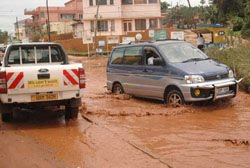
Many of us spent years in Uganda, our brother to the east. Parties, laughter, debate, and flamboyance mark the joys our eastern brother. Yet another marker of our eastern brother is the roads. In fact, roads are usually the first item of conversation our eastern brothers raise when they visit Kigali. Something is horribly wrong with Kampala. It is the roads. Something is right with Kigali. It is the roads.
Metaphors are dangerous communication devices. They turn the profound and complex into a simple symbol. Yet they resonate. The tragedies of our Great Lake’s history can be obviously seen in our roads.
Two weeks ago, I compared Nairobi’s roads to Kigali’s and concluded the fatal flaw of Nairobi’s roads was poor colonial vision. Nairobi would have been a perfect city with perfect roads if only Nairobi had remained a city of no more than 250,000 making the life of British administrators comfortable. Nairobi refused to be contained by such a short-sighted vision.
A journey to Kampala easily sees the same problem. The best traditional neighborhoods of Kololo and Nakasero would have been perfect if not for Uganda’s Independence. Yet, I propose another reason that Kampala’s roads are so disastrous – Far too few fathers play with their children in sandboxes.
My earliest childhood memories are of my mom and me following my dad’s labor. He was a road builder. The profession literally required, “Life on the road.” When we would enter a new city mom sought a park where we could play. Thus my first habit in a new town is always asking, “Where can my children play?” When we moved to Kigali we found the Kimihurura roundabout by the Prime Minister’s Office, and knew we were at home. As I became school age, dad continued to travel while mom kept me in school. My second question in a new town is “Where will my children go to school?” Thus I’m a fervent believer in education.
During down time my dad had a sandbox for us. Into the sand came a few toy replicas of the construction equipment my father mastered – trucks, dozers, and graders. We played together and my father taught me the basics of civil engineering. Enduring roads require drainage. You must have a good ditch. If not, water will rapidly erode the roads.
During the winter construction stopped. However, for there to be work in the summer my dad submitted bids to tendering boards. When there were school breaks I went with him to the reading of bids. We had breakfast before the bids were opened with old friends of his who worked for other construction companies.
As my brothers and I were in school dad was away and only home on the weekends. He labored hard and sometimes work was frustrating. Mom heard his frustrations on the difficult weeks. Once I overheard him say, “I don’t care whether a man is black, white, purple, or polka dot. I want to work with men who tell the truth.” I noticed he no longer considered his old friends to be his friends.
A few years later I overheard a rumor. My dad’s old friends had been caught in a bid rigging scheme. The scheme involved brief case construction companies that manipulated racial quotas. My dad’s old friends went to prison.
During my secondary years my dad came to every football and basketball game I played. Whenever he was not working he gathered my brothers and me for excursions in the lakes and forests of our home village. My dad’s old friends were in prison. He didn’t know that I knew.
He visited me once while we lived in Uganda. He never could understand Uganda’s roads. They were offensive to everything my dad considered right, good, and true. They were full of potholes, no drainage, nothing straight, and worst of all abundant evidence of poor workmanship and “eaten” resources. His mind never stopped trying to find a way to fix Uganda’s roads. Finally, he came to a conclusion, “Start over.” Tear up every road, relay the foundation, install drainage, then put on a good thick layer of tarmac. Only in a complete start over was there hope.
A few years ago, I was at my parent’s retirement home in the village. We had a quiet morning’s breakfast. I started asking questions about my dad’s labor and childhood memories. He did not know I knew his old friends had gone to prison for bid rigging. Children learn things from their parents without them knowing.
I know why Uganda’s roads are such a disaster. No sandboxes. Little boys are not playing with their fathers who model to them the satisfaction of an honest day’s labor. In those sandboxes come pragmatic lessons. Drainage is essential for a good road. Also, in those sandboxes are more philosophic lessons taught. Truth is more important than profit. Honor is more important than relationship. Not every action of truth and honor is immediately rewarded. Yet, over time truth and honor build enduring infrastructure and institutions.
I studied theology in university. I built roads with my dad to pay for my tuition. I’m not a civil engineer, but I know the basics of road building with honor.
I like engineering students in Kigali. I lecture for many reasons. One is my dad played with me in a sandbox between building enduring roads. I hope my students have similar people in their lives.
Something is horribly wrong with Kampala. It is the roads. Something is right with Kigali. It is the roads. We thank God for older generations who taught us to play, study, and labor with truth and honor.
Metaphors are dangerous communication devices. They turn the profound and complex into a simple symbol. Yet they resonate. The tragedies of our Great Lake’s history can be obviously seen in our roads.
Two weeks ago, I compared Nairobi’s roads to Kigali’s and concluded the fatal flaw of Nairobi’s roads was poor colonial vision. Nairobi would have been a perfect city with perfect roads if only Nairobi had remained a city of no more than 250,000 making the life of British administrators comfortable. Nairobi refused to be contained by such a short-sighted vision.
A journey to Kampala easily sees the same problem. The best traditional neighborhoods of Kololo and Nakasero would have been perfect if not for Uganda’s Independence. Yet, I propose another reason that Kampala’s roads are so disastrous – Far too few fathers play with their children in sandboxes.
My earliest childhood memories are of my mom and me following my dad’s labor. He was a road builder. The profession literally required, “Life on the road.” When we would enter a new city mom sought a park where we could play. Thus my first habit in a new town is always asking, “Where can my children play?” When we moved to Kigali we found the Kimihurura roundabout by the Prime Minister’s Office, and knew we were at home. As I became school age, dad continued to travel while mom kept me in school. My second question in a new town is “Where will my children go to school?” Thus I’m a fervent believer in education.
During down time my dad had a sandbox for us. Into the sand came a few toy replicas of the construction equipment my father mastered – trucks, dozers, and graders. We played together and my father taught me the basics of civil engineering. Enduring roads require drainage. You must have a good ditch. If not, water will rapidly erode the roads.
During the winter construction stopped. However, for there to be work in the summer my dad submitted bids to tendering boards. When there were school breaks I went with him to the reading of bids. We had breakfast before the bids were opened with old friends of his who worked for other construction companies.
As my brothers and I were in school dad was away and only home on the weekends. He labored hard and sometimes work was frustrating. Mom heard his frustrations on the difficult weeks. Once I overheard him say, “I don’t care whether a man is black, white, purple, or polka dot. I want to work with men who tell the truth.” I noticed he no longer considered his old friends to be his friends.
A few years later I overheard a rumor. My dad’s old friends had been caught in a bid rigging scheme. The scheme involved brief case construction companies that manipulated racial quotas. My dad’s old friends went to prison.
During my secondary years my dad came to every football and basketball game I played. Whenever he was not working he gathered my brothers and me for excursions in the lakes and forests of our home village. My dad’s old friends were in prison. He didn’t know that I knew.
He visited me once while we lived in Uganda. He never could understand Uganda’s roads. They were offensive to everything my dad considered right, good, and true. They were full of potholes, no drainage, nothing straight, and worst of all abundant evidence of poor workmanship and “eaten” resources. His mind never stopped trying to find a way to fix Uganda’s roads. Finally, he came to a conclusion, “Start over.” Tear up every road, relay the foundation, install drainage, then put on a good thick layer of tarmac. Only in a complete start over was there hope.
A few years ago, I was at my parent’s retirement home in the village. We had a quiet morning’s breakfast. I started asking questions about my dad’s labor and childhood memories. He did not know I knew his old friends had gone to prison for bid rigging. Children learn things from their parents without them knowing.
I know why Uganda’s roads are such a disaster. No sandboxes. Little boys are not playing with their fathers who model to them the satisfaction of an honest day’s labor. In those sandboxes come pragmatic lessons. Drainage is essential for a good road. Also, in those sandboxes are more philosophic lessons taught. Truth is more important than profit. Honor is more important than relationship. Not every action of truth and honor is immediately rewarded. Yet, over time truth and honor build enduring infrastructure and institutions.
I studied theology in university. I built roads with my dad to pay for my tuition. I’m not a civil engineer, but I know the basics of road building with honor.
I like engineering students in Kigali. I lecture for many reasons. One is my dad played with me in a sandbox between building enduring roads. I hope my students have similar people in their lives.
Something is horribly wrong with Kampala. It is the roads. Something is right with Kigali. It is the roads. We thank God for older generations who taught us to play, study, and labor with truth and honor.
Subscribe to:
Posts (Atom)