Showing posts with label Honor. Show all posts

Friday, May 10, 2013

THE JOY OF THE MISSIONARY CALL


Senator and friend, Marguerite Nyagahura with our foster son, Gabe

There were many privileges the Lord gave us during our season in East Africa.  One of the greatest ones was joy in our friendships with the African people with whom we served.   We had a few furloughs where we returned to the United States wounded by religious charlatans.   We know missionaries whose return to the United States came during a season of wounding that created Afro pessimism and spiritual bitterness.   Yet, in our departure from Africa’s Great Lakes we had an immense sense of fulfillment.   The institutions we labored to build were stronger than our charisma.   They endure.   Also, our friendships blossomed.   Those we shepherded blessed us.   We are immensely grateful.

            Our missionary calling is a unique spiritual gift.  We believe to be a missionary is to be one sent from one’s earthly home by the Holy Spirit for the purpose of making disciples and developing churches.   That call means over time we become a cultural insider who is never completely at home.   Thus we’re prophetic in holding leaders accountable while pastoral in building institutions that bless coming generations until the Lord returns.   This calling is from the Holy Spirit.   It is never about economic power, race, or national origin.  Only a few will hear a missionary call.   Yet, the call is never restricted to those from certain earthly privileges.

            We believe all cultures need missionaries in their midst.  We observed that over time the missionary vocation became a great source of social strength in East Africa.   Our heritage not only developed churches.  We built schools and scholarship programs.   We counseled diverse national leaders.  We helped the poorest of the poor and most vulnerable.

            Our family believes our new call is to serve the Diaspora from Africa’s Great Lakes who are in North America.  We believe we are doing what missionaries always do.   The Lord is leading us to new niches that most do not see.   A typical weekend for us involves going to social functions of Diaspora in Chicago.  Sometimes we know someone at the function.   Yet, sometimes it is simple beginning introductions.

            We usually say these words, “We are very thankful for the 19 years the Lord gave us as adults in East Africa.   He put a missionary gift in our heart.   We believe we are still to be missionaries even when we return to the USA.”

     
Paulin Byusa, Ame Ishimwe, Joseph Masengeshu, Joris Manzi at Commemoration
      
Then spiritual magic happens.   We are met with smiles.   We are met with stories.

            “I went to a missionary school.”


            “A missionary sponsored me and found a scholarship for me to study abroad.”


            “A missionary baptized me.”


            “A missionary performed my wedding.”


            “A missionary prayed for me (or my child, nephew, niece, grandchild, etc…) when I was sick and I was healed.”


            “A missionary counseled a difficult situation in our community and brought unity.”


            “A missionary kept my mom safe during a season of turmoil and strife.”

            We are immensely thankful for such a heritage.   Yet this heritage is not one to hoard.   It calls us to see new community needs, and initiate.   In the process we make many mistakes.   Yet, God’s grace goes far beyond our failings.   Thus the Lord is glorified.

      
      In April as Rwanda faced the month of mourning the tragedy of the 1994 Genocide we sensed it was time to pastorally initiate a commemoration.  As it closed a few Diaspora told us thank you.   The Chicago Rwanda Genocide Memorial would not have happened without a missionary in the Diaspora midst.

            We then spoke something that our missionary elder statesman once said to us.

            “Don’t give me any honor for this.  It was just a missionary thing to do.   The honor needs to go to the Holy Spirit which called us.   All this call is about is discerning when the community has a need that can only be met by an outsider understanding enough to initiate.


            You can be a missionary too.   You are away from home.   America needs you to be a missionary to them.   You will return to your African home someday.  When you return go as a missionary.   Be a Holy Spirit inspired starter.”

            To one thankful Diaspora mom we said, “Again this is no big deal.  It is just a missionary
Diaspora kids - Christian, Zam, and Aisha sharing a meal in our home
call.  The Holy Spirit may call your children to be missionaries too.  If so, bless your children in that call.”

            This is pure missionary joy.  We empathetically understand these old missionary words generations upon generations have repeated, 

 "I can’t tell you how happy I am to learn that many members of your family are diligent in living out the Truth, exactly as commanded by the Father. But permit me a reminder, friends, and this is not a new commandment but simply a repetition of our original and basic charter: that we love each other (2 John 1:4-6, The Message with a little tweak.)"

Friday, February 10, 2012

FATHERS, SANDBOXES, AND ENDURING ROADS


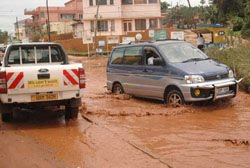
Many of us spent years in Uganda, our brother to the east. Parties, laughter, debate, and flamboyance mark the joys our eastern brother. Yet another marker of our eastern brother is the roads. In fact, roads are usually the first item of conversation our eastern brothers raise when they visit Kiga­li. Something is horribly wrong with Kampala. It is the roads. Something is right with Kigali. It is the roads.

Metaphors are dangerous com­munication devices. They turn the profound and complex into a simple symbol. Yet they resonate. The trag­edies of our Great Lake’s history can be obviously seen in our roads.

Two weeks ago, I compared Nairo­bi’s roads to Kigali’s and concluded the fatal flaw of Nairobi’s roads was poor colonial vision. Nairobi would have been a perfect city with perfect roads if only Nairobi had remained a city of no more than 250,000 making the life of British administrators com­fortable. Nairobi refused to be con­tained by such a short-sighted vision.

A journey to Kampala easily sees the same problem. The best tradi­tional neighborhoods of Kololo and Nakasero would have been perfect if not for Uganda’s Independence. Yet, I propose another reason that Kam­pala’s roads are so disastrous – Far too few fathers play with their chil­dren in sandboxes.

My earliest childhood memories are of my mom and me following my dad’s labor. He was a road build­er. The profession literally required, “Life on the road.” When we would enter a new city mom sought a park where we could play. Thus my first habit in a new town is always ask­ing, “Where can my children play?” When we moved to Kigali we found the Kimihurura roundabout by the Prime Minister’s Office, and knew we were at home. As I became school age, dad continued to travel while mom kept me in school. My second question in a new town is “Where will my children go to school?” Thus I’m a fervent believer in education.

During down time my dad had a sandbox for us. Into the sand came a few toy replicas of the construc­tion equipment my father mastered – trucks, dozers, and graders. We played together and my father taught me the basics of civil engineering. Enduring roads require drainage. You must have a good ditch. If not, water will rapidly erode the roads.

During the winter construction stopped. However, for there to be work in the summer my dad submit­ted bids to tendering boards. When there were school breaks I went with him to the reading of bids. We had breakfast before the bids were opened with old friends of his who worked for other construction com­panies.

As my brothers and I were in school dad was away and only home on the weekends. He labored hard and sometimes work was frustrat­ing. Mom heard his frustrations on the difficult weeks. Once I overheard him say, “I don’t care whether a man is black, white, purple, or polka dot. I want to work with men who tell the truth.” I noticed he no longer consid­ered his old friends to be his friends.

A few years later I overheard a ru­mor. My dad’s old friends had been caught in a bid rigging scheme. The scheme involved brief case construc­tion companies that manipulated racial quotas. My dad’s old friends went to prison.

During my secondary years my dad came to every football and bas­ketball game I played. Whenever he was not working he gathered my brothers and me for excursions in the lakes and forests of our home village. My dad’s old friends were in prison. He didn’t know that I knew.

He visited me once while we lived in Uganda. He never could under­stand Uganda’s roads. They were of­fensive to everything my dad consid­ered right, good, and true. They were full of potholes, no drainage, nothing straight, and worst of all abundant evidence of poor workmanship and “eaten” resources. His mind never stopped trying to find a way to fix Uganda’s roads. Finally, he came to a conclusion, “Start over.” Tear up ev­ery road, relay the foundation, install drainage, then put on a good thick layer of tarmac. Only in a complete start over was there hope.

A few years ago, I was at my par­ent’s retirement home in the village. We had a quiet morning’s breakfast. I started asking questions about my dad’s labor and childhood memo­ries. He did not know I knew his old friends had gone to prison for bid rigging. Children learn things from their parents without them knowing.

I know why Uganda’s roads are such a disaster. No sandboxes. Little boys are not playing with their fa­thers who model to them the satisfac­tion of an honest day’s labor. In those sandboxes come pragmatic lessons. Drainage is essential for a good road. Also, in those sandboxes are more philosophic lessons taught. Truth is more important than profit. Honor is more important than relationship. Not every action of truth and honor is immediately rewarded. Yet, over time truth and honor build enduring infrastructure and institutions.

I studied theology in university. I built roads with my dad to pay for my tuition. I’m not a civil engineer, but I know the basics of road build­ing with honor.

I like engineering students in Kiga­li. I lecture for many reasons. One is my dad played with me in a sandbox between building enduring roads. I hope my students have similar peo­ple in their lives.

Something is horribly wrong with Kampala. It is the roads. Something is right with Kigali. It is the roads. We thank God for older generations who taught us to play, study, and labor with truth and honor.