Showing posts with label Adoption. Show all posts

Tuesday, January 1, 2013

THERE ARE NO FORGOTTEN BIRTHDAYS


The humble one’s stories are too easily forgotten.    This morning as I checked my Facebook I had 37 friends whose birthday is January 1.     On an average day I should have 8 or 9 friends to wish a birthday.   (3,051 Facebook friends divided by 365 days in a year equals 8.35 friend’s birthdays per day.)    Today, there is a 411% increase in birthday averages.   What is up?

A couple of my Bazungu (white, or those who wander in circles) friends truly know that January 1 is their birthday.    A couple of my friends from Africa who were fortunate to have their mother deliver in a hospital during a day of relative peace truly know that January 1 is their birthday.

Yet, for the majority of my 37 Facebook friends today they were born during a season of absolute chaos.    They were born in places like remote villages, refugee camps, and urban slums.   Their mom was one of the world’s poorest of poor.    She was likely on the run.  Their mom was thankful to have lived through delivery, and today is exceptionally thankful the child born on that day is alive.
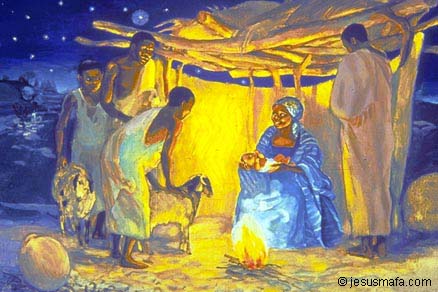
These friends of mine share a common past with my boss, Jesus of Nazareth.   He too was born in poverty (Luke 2:1-21).     Stables and mangers in church nativity scenes frequently miss this point.    If you can’t smell the manure your church has understated the chaos of Jesus’ birth.    Jesus was born in forced circumstance as his nation, Judah was under Roman occupation.    His parents were forced to travel near the end of his mom, Mary’s pregnancy just to register for a census and pay tax.    Forcing a pregnant woman to travel is the height of oppressive government policy.    

These friends of mine share another common past with my boss, Jesus of Nazareth.   His family too was forced to flee for their safety as refugees (Matthew 2:13-18.)    An evil despot intended to kill all rivals, and that included infant boys in a remote village.     Despots do the same things today.

Where is God in such circumstances?

Paul in describing the riches of knowing Christ tells an unfathomable truth (Ephesians 1.)    Before creation God in His infinite knowledge knew His creation would rebel.     God’s holiness could not dwell with rebellion.    Our rebellion would cause eternal separation from the God of infinite love.     The consequence was as horrific as an infant child abandoned and left to die in a field (Ezekiel 16:4-6.)    God chose to rescue us by sacrificing the life of His own Son.    In the process He took us rebels, and adopted us into His family.    Can you imagine?    He knew every sin we would commit.   He knew the horrific costs.   Yet, He chose to create what He would redeem though sacrifice.    Amazing.  Jesus is Emmanuel, God near and with us.

In the chaos that humanity lives God watches every movement of life.   In God’s eyes there are no forgotten birthdays.  His word states,

“Yet you brought me out of the womb; you made me trust in you, even at my mother’s breast (Psalm 22:9.)”

“For you created my inmost being; you knit me together in my mother’s womb (Psalm 139:13.)”

“This is what the LORD says— he who made you, who formed you in the womb, and who will help you: Do not be afraid… whom I have chosen (Isaiah 44:2.)”

“This is what the LORD says— your Redeemer, who formed you in the womb: I am the LORD, the Maker of all things, who stretches out the heavens, who spreads out the earth by myself… (Isaiah 44:24.)”

“Before I was born the LORD called me; from my mother’s womb he has spoken my name. (Isaiah 49:1.)”

“And now the LORD says— he who formed me in the womb to be his servant (Isaiah 49:4.)”

Before I formed you in the womb I knew you, before you were born I set you apart; (Jeremiah 1:5.)”

In eternity, God will redeem each one of these chaotic births.   In God’s eyes there are no forgotten birthdays.   Yet, we do live in the here and now.   Is there hope in this life for God to bring good out of chaos?

Absolutely.    God is sovereign.   He is good.    He is full of love.  His ways are mysterious.   Yet, His ways are just.    History is full of stories of God bringing good from chaos.

One of the privileges God gave me during my season in Rwanda was to be a facilitator in the Presidential Scholars program.   Facilitator sounds important.   All I did was pragmatically pastor.  I made friends.    I helped friends communicate to one another.    Sometimes it was rather mundane.   One of the mundane moments was filling out visa applications.    The applications required filling out a date of birth.    Many times we wrote in the application January 1, _______.

Most of those bright young Banyarwanda who wrote January 1, ______ were not born on January 1, ______.    Instead they were born during absolute chaos.     All their family can remember is a year filled with turmoil.    In some ways, God has helped them forgive the sources of the chaos, and in the process forget a few details that would even include the month of the birth.   

Rwanda Presidential Scholars at Hendrix College
Yet, something wonderful happened in the years following the traumatic birth.    Enough peace came that a family could survive.    They could put down a root somewhere.    The kids could go to school.    Many times the schools were barely functioning.    Yet, somehow learning happened.    The brightest students found a place of marginal stability and success.    They kept at it for years.    Then they sat their final secondary exam.   They scored near the top of all the students in the nation.     Then they received an opportunity to interview with the different universities offering scholarships.    For some of these bright Banyarwanda, this was the first time they had even been in the capital of Kigali.   If there was no God they would have had no chance.    Yet, there is a God.  He is good.   He enjoys showing His grace upon the most humble.   These kids whose families don’t remember their birthday were offered scholarships to attend prestigious universities in the United States.   God is good.

So today I ask that if you definitely know the day of your birth thank God.    Much of the world does not have that luxury.   If you’re one of those who wrote January 1, _____, but really don’t know; also thank God.   If you meet someone with a January 1, ____ birthday, listen to their story.   Thank God.   He is good.  There are no forgotten birthdays.

Tuesday, December 25, 2012

GIVE A LITTE EXTRA TO A MISSIONARY THIS CHRISTMAS SEASON


12 year old Jesus with the teachers
Have you received a letter by post or email this season with a photo of an African child in need of sponsorship?   Yet, when you look at the state of Christianity in America do you feel like we need to do something at home?   Then when you read the news from Africa does something just not add up?


You are not alone in your hesitancy and concerns.

Dambisa Moyo
A couple of weeks ago, John Uwimana, a Rwanda Presidential Scholar in a master’s degree program at DePaul University and I attended a lecture by Dambisa Moyo at the University of Chicago.   If you have not read Dambisa’s writing (Dead Aid; How the West was Lost; and Winner Take All), and the above questions resonate, you should.   She’s one of the sharpest economic thinkers in the world.   She has well documented how the Aid industry is actually doing more harm than good in Africa.    After her lecture she fielded questions.     She discussed a conversation with Rwanda’s President Kagame in which he told her the greatest pitfall of Aid as we know it is that it strips the recipient of their dignity.   She then told us she would write letters of complaint to the nonprofit organizations that send her fund raising letters with photos of poor African children.   She pointed out a principle Jesus repeatedly stated.   We should treat others the way we want to be treated.    If photos of poor American children were being distributed around the world many of us in America would write letters of complaint.   Africa should be treated with the same dignity.


March, 1993 - The last time until now we were USA residents
It’s been 20 years since our family has put down roots in the United States.   Many things have changed.   One thing we are reading and observing is that the evangelical church is losing influence (http://www.nytimes.com/2012/12/16/opinion/sunday/the-decline-of-evangelical-america.html?pagewanted=all&_r=0.)    The American church needs a reboot.    I think the American church needs a new generation of missionaries in her midst.   My thoughts have been influenced by old missionaries.   They defined missionaries as those sent by the Holy Spirit to make disciples and develop churches.   The definition goes beyond nation, race, and sending mechanism.   A friend of mine in Chicago, Emmanuel Tahear with Service in Missions is praying for a new revival in America.   He thinks it will likely come from the influence of immigrants to North America.   He has a point.    America’s historic revivals were frequently led by first and second generation immigrants (I.e. George Whitefield, and Thomas and Alexander Campbell.)    Currently, immigrant churches are growing.   Currently, international students are strengthening the American academic landscape.  Also their presence adds vitality to American churches.    A couple of the churches that are now starting to make very significant inroads in America’s major cities are led by the children of immigrants.

Rwanda Presidential Scholar at Milsaps College, Fabio Pie Ntagwabira
Every culture needs missionaries to come from the outside with a new found entrepreneurial impulse triggered by the Holy Spirit.    Without these newcomers who master culture and then find a new possibility our faith becomes both stagnate to our spirits and irrelevant to our culture.

This Christmas season I ask that you do something practical that will build both the church in North America and the church abroad.

If you are near a university meet some international students.   Have them over for dinner.   Ask them some questions.   Listen.    Invite them to church.   Encourage them to use their spiritual gifts in your local church.   Your church will rediscover old disciplines like hospitality, vibrant worship, and practical Bible teaching when these missionaries are in your midst.


Next, consider writing a check to support a good missionary abroad.    There are many.   In fact, I know many in many different organizations and in many different nations.


ROC Missionaries - Jamie Boiles, Hixsons, Jenkins, Lindens, and Shrecks
Yet, God has given me four missionary families who are my colleagues – Jamie Boiles, Bryan and Holly Hixson, Rusty and Onawa Linden, and Brett and Kelli Shreck with ROC (Rwanda Outreach and Community) Partners.   Of the many missionaries I know these are the ones I know best.   God’s done the remarkable through them.

A Rwandan entrepreneur friend, Clarisse Irabagiza once read a blog of mine on missionaries ( http://jenkinsinrwanda.blogspot.com/2010/07/are-missionaries-most-controversial.html)  and remarked most missionaries she’s know are irrelevant.   Yet, she singled out ROC missionaries as ones making a very significant impact.   Why?

Clarisse Irabagiza
Just lay the ROC missionaries labor next to the words of Jesus.

He told His disciples to focus on the receptive (Matthew 10.)   They’ve gone to a place God is moving, joined God’s activity in Rwanda, and the ministry has gone boom.    Who else do you know who’ve taken a local church from an idea to 350 to 400 in attendance among a nation’s thought leaders in such a short time?   Who else has been able to start and get an international school accredited in such a short time?    Who else has found so many scholarships, taught so many classes and seminars, equipped so many, and participated in so much national dialogue?


Second, Jesus taught to treat others as we want to be treated.   That means those we minister with are friends.   They are not photo opportunities, contacts, nor marketing tools.    Look at the Facebook photos of ROC missionaries.   They don’t market themselves as saviors.   They tell the stories of Jesus as the savior of humanity.    Yes, on occasion ROC missionaries do help individuals in desperate situations.   Those of you in healthy churches in America do the same thing.    ROC missionaries simply embrace the teaching of Jesus.   Children belong in families.    All humanity deserves dignity.   When one is in a difficult situation God’s people respond in ways where joy and hope triumph.   Their photos are stories of God’s triumph and even come with silly laughter.


Third, Jesus’ mission was preceded by two historical events.   One was the Jews who returned form Babylonian exile as builders.   Two, was the Roman Empire which created peace, shared language, transportation infra-structure, and economic markets.   Jesus’ followers were at times persecuted, but overall the systems were in place that allowed the Gospel to quickly spread and put down roots.    Our American predecessors did the same thing.    They built churches, schools, roads, railroads, and businesses on the American frontier.   After the Second World War they ushered America into a new found place of prosperity and influence.    The best African minds will point out that the best missionaries in Africa do the same things.   My friend, Andrew Mwenda summarizes this institutional initiative needed for Africa with the words, “Leaders make things happen.   Institutions make them last.” ROC missionaries are part of this tradition.     They not only care for individuals with the love of Christ, they address foundational issues that build prosperity.   They preach old Gospel messages of adoption.   They teach sound ethics.   They strengthen Rwanda’s business climate.   They build schools.   They help others build educational systems.

Thus I request that this Christmas season you give a little extra to a missionary.   First, give some extra care to the missionaries God has brought to the United States.   Second, give a little extra donation to the missionaries God has called to leave the United States.   Both are building the dignity of man and making lasting changes for generations.

Friday, December 21, 2012

DON'T SETTLE FOR INCOMPLETE LOVE


Both English and the vernaculars of my earthly home (Africa’s Great Lakes) don’t adequately communicate the depth of possibilities and meaning for what in English we call “Love.”    Maybe, even our linguistic shortcoming is actually an indictment of the failings of our humanity.    We many times say “I love ____” when our real meaning is “I want ___,”   “I need ____,” and “I desire _____.”    This is the toddler view of love.   In the toddler view love is a means of acquisition for selfish gain.    

                A few years ago, my older children were quarreling over “fault.”   According to each one’s perspective the problem of the day was not “their fault,” but “the fault of the competing sibling.    My youngest at the time was a toddler beginning his language acquisition.    When he heard an argument over possession he ran to the middle of the argument pushed his siblings aside, and proclaimed, “No.  It is my fault.”   His toddler view of love required him to acquire all he could.   Siblings get out of the way.

                We giggle at toddler view of love as acquisition.   Yet, maturity only brings sophistication in love as acquisition.    

                I’ve spent most of my adult life pastoring.    Much of that has been in places of the world with less financial resources than the United States.    I’ve seen many moments of both heart break and triumph.   All stir our emotions.   When our emotions stir we use the language of love to convey what is happening.    In these moments we often settle for incomplete love.    Our incomplete love sees humans as tools for acquisition.    Humanity becomes photo opportunities, blogs, marketing material, and laborers in an acquisition race for more resources and influence.

                Sovereign God created language.   Humanity is always recreating.   At certain moments in time we get it right.    During the season that Jesus walked the earth one word to describe love was the Greek word “phileo,” the love of brothers and friends.

Ballet Rwanda December 2011
                We can’t survive without the love of siblings and friends.     Little girls on the playground become friends and share their feelings.  Little boys quickly find playmates for the games and competitions of life.   As time goes on we thrive in a community of camaraderie no matter our age.   We know it is the glue of life.   It creates a community that plays and laughs together.    Our experiences are shared.   Even the painful experiences become internal jokes in phileo.   High success teams are high phileo teams.    

Yet phileo is an incomplete love.   It is a love of inclusion based upon common joy in pursuit.    What happens when our community must include another who does not share the common past?    What happens when jokes aren’t funny?   What happens when another’s fashion is awkward?   Even what happens when someone on the team smells bad?    If our love is only phileo it is incomplete.    This is particularly true for those of us called to shepherd.   Maybe it is even more so for those of us shepherding far from our shared joy in pursuit?

CCR's Covenant Handover of Gabriel Mugisha Jacobs
                Before Jesus began walking the earth his Hebrew predecessors used the word, “hessed” to describe love.   English has no single word to describe this love.    Many translate it as “steadfast loving kindness.”    When our colleague doesn’t share our past, tells bad jokes, wears awkward fashion, and smells bad; we must make a choice.   We choose to practice hessed.    We remember we live in covenant.   We’ve made a commitment to this relationship and this endeavor.     The commitment is one we cannot leave.    In fact, the Old Testament uses hessed to describe this hessed love of God in its fullness.   God keeps His covenants even when we humans abandon ours.   He is always there for us.    Also, His care is the gentle nurture of kindness.   Hessed makes our love more complete.    Typically, we see it in matters like enduring marriages and business partnerships.    Local churches thrive when they have a consistent pastoral presence.    Hessed is seen when you watch couples at 50 year anniversaries giggling and flirting with one another.    It also is seen when business partners retire as friends.    Pastors who practice hessed answer late night phone calls.    They come to be with their people when the easiest thing to do is to hide behind professionalism.   Hessed is one of the reasons I am such an advocate for marriage when a society is recovering from internal turmoil.   Hessed brings unity.   It broadens and strengthens extended families.   Over generations hessed builds national unity.    Yet, hessed is an incomplete love.    

                Hessed is about kindness in covenant.   What happens when covenants are not formed?   What happens when our covenant community has conflict with another covenant community?  Feuds and civil wars come with such fury because our internal hessed desire has gone astray.    In fact, humanity’s greatest tragedies of depravity were ones when covenant became exclusive.   What united was the destruction of another community.   Hessed can be an incomplete love.

                One of the pitfalls of hessed is that we do not “feel” with all other humanity.    In conflict we tend to dehumanize our opponents.   We strip them of humanity and portray them as demons.   Conversely, we tend to make our leaders such human demi-gods that we forget God is the hero of humanity’s stories.    

                I am an American evangelical who has lived most of my adult life in Africa’s Great Lakes.    My hessed community is a very broad and at times a contradictory one.    

Kampala Kids League Simba Team
                One of my favorite memories from our Uganda season was volunteering with Kampala Kid’s League (KKL.)    It once pushed my hessed to the very edge of my humanity.   I was once assigned to coach the Libyan ambassador’s daughter.    My American evangelical clan would have wanted for me to consider this child an enemy.   During our first practice she called me, “Sir.  She was a good athlete.   She was a born leader.    She cheered for all the other kids on our team.   She won me over rapidly.   For her, race, nationality, and religion were irrelevant to both our humanity and our shared team goals.   I found myself deeply regretting the hatred my American evangelical clan had taught me towards Libya.   I never met her dad.   The bodyguards quickly ushered her away from practices and games.   Yet, she was one of those young people that as time matured I hoped would no longer call me, “Coach and Sir,” but “friend.”

                The Arab Spring struck a small terror in my heart.   I had not seen this delightful young woman in years.   I guessed her family could be in danger.    I searched for her on Facebook.    I asked old coaches if they knew how she was doing.    I even asked friends in media and government who may have known the family’s whereabouts.   The ones who may have known giggled.   Only a pastor could ask these questions and be taken serious.   If they knew the answer they had to be quiet.

                I know many in our Great Lakes of Africa region have Libyan friends.   I chose to pray for this girl publicly at Christ’s Church in Rwanda.   I watched heads nod among my African brothers and sisters when I said, “I have Libyan friends.   I don’t know if they are safe.   I don’t care that much about the politics, but I do care about my friends.   Can you pray with me?”   CCR is a multi-national church.   An American Embassy employee told me he felt the same way.   Yet, another couple of Americans were offended and left.   

                As my concern increased, and I could find no news through relationship networks I turned to Google.   I created a bunch of different searches.   I found my old friend.   She was safe.   She had signed a petition about the environment at a university function.   My guess is her family had decided to keep her almost untraceable, and I stumbled upon her last voice.   It was classic for her.   She was rallying others to a cause that was good.   In the Google search I also came across a list of Colonel Muammar Gaddafi mistresses.  One suspected mistress was the grandmother of my friend.   The internet is a strange source of news and information.   It thrives on rumors.   Sometimes it whispers what we all intuitively know is true, but cannot say or document.   Sometimes it just spreads untruthful mythology.   Was my friend, Gaddafi’s granddaughter?  I do not know, but the story has elements of consistency with what I know of her body guards, connections, and inherited athleticism and charisma.

                When much of the world cheered at Gaddafi’s death I grieved.   I remembered a little girl who called me, “Sir,” and brought out the best in our team.   Phileo and hessed had taken me to a new place of love called compassion.    The thought of a little girl as a young woman crying over the loss of her grandfather caused me to cry in pain.
               
After weeping with Mary and Martha Jesus brought Lazarus to life
                The Greek language of Jesus’ day used the word splaxna to describe this love of compassion.   Splaxna is the word from which English creates spleen.   Jesus’ compassion was the love that causes us to literally have “shaky guts” for others.     It is humanity in our created glory.    When one in our community is in trouble we feel their pain.    Our bodies and spirits feel inconsolable pain with another.   The shortest verse in the Bible is, “Jesus wept (John 11:35.)”   We memorize it as children.   As adults we remember it when we cry for joy at weddings and weep with grief at funerals.    Compassion is the point where our human dignity in the flesh meets the divine.   We feel the emotions that God himself feels.   These emotions are passionate.   They strengthen all the parts of our incomplete loves of phileo and hessed.    Compassion makes us both better friends and better covenant keepers.  Compassion reminds the old married couple of who was holding their hand when they woke up from surgery.   Compassion causes middle class families to adopt orphans and give them full legal and relationship rights.    Compassion causes us to sacrifice for another with joy.    Compassion requires for us to move beyond feelings to action.

                Yet, compassion is an incomplete love.    Compassion requires for us to be present.   It is neither a distant love nor a fantasy world.    The Aid industry thrives on incomplete compassion.   In fact, during December as year-end gifts are sought pseudo compassion becomes a thriving marketing tool.    The west is bombarded by images of poor children in developing nations.     A missionary friend of mine called this marketing tool, “vicarious grief.”   The emotion is truly felt.   Yet presence is not given.   Vicarious grief makes it easy to “like” on Facebook and re-tweet on Twitter.   Vicarious grief makes it easy to stop for a moment in channel surfing.   Vicarious grief allows one to feel they are a participant when they are not.     It actually leads to a dulling of humanity.   It strips the suffering of their dignity.   It creates an emotion, but it is not an authentic emotion of presence.   Vicarious grief becomes an addictive cycle of seeking a more shocking photo or story to stir emotions and raise resources.   It is no wonder why so many thought leaders outside of the United States emotions quickly turn to anger at marketing that promotes vicarious grief.

                Phileo, hessed, and splaxna are love.   They are real.   They are part of being human.   They bring us to a place of behaving like God.   Yet, each in a certain way is a love with a reward.   Phileo creates friendship.   Hessed creates trust.    Splaxna creates passion.    Life requires all.

                Yet, these loves are completed in another word in which both English and Great Lakes’ vernaculars cannot express in a single word.    The Greeks called this word agape.    This is the love of relinquishment.   It is the love of sacrifice.   It is the love where there is no personal return.   It is the love that endures over time.    It is supremely seen in Jesus, the Son of God giving up all the glories of heaven to dwell with men.   He laughed with us.   He made water to wine to keep the party going.   He called us friends.    He covenanted and promised to always dwell with us.   When he saw our pain he wept.   He used his full authority to remove our pain.    Yet, his authority could not remove the eternal pain of suffering our sin created.    Thus in the love of agape sacrifice he laid down his life.   His surrender was brutal.    His agape bought our freedom.

                Today, agape completes our incomplete love.   We rarely truly see agape, because it is the love of relinquishment.   It brings little glory.   It returns little in the immediate.    Yet, it is the love that endures.    Maybe, we see agape best when one after a long struggle relinquishes all the rewards of the struggle?   Maybe, we see it best when a leader steps aside in his prime of leadership so that another generation can lead?   Maybe, we see it best when a leader chooses to make his institution stronger than his charisma?

                Agape completes our hopes of human love.   It takes us beyond the love of toddlers for acquisition.  Our words can barely express this sacrificial love of relinquishment.    May we instead live it.