
I
woke this morning to startling news from a friend in Rwanda. Honorable Minister of Gender and Family
Promotion, Aloysia Inyumba has passed from this life to another. She leaves behind a husband and two
children. Our
region’s newspapers quickly began coverage
of a remarkable woman. Social
media told the more personal details.
It is astounding to quickly observe on Twitter and Facebook how the titles we gave her moved from “Honorable
Minister” to “Mother,” “Auntie,” “Mentor,”
and “Friend.” She was a woman who
quickly could bring us into places of great warmth and hospitality. In the end she believed in many of us more
than we believed in ourselves. I
wonder if there are any in Rwanda who have not in some way been touched by
Minister Inyumba. Many of our best efforts and accomplishments were nurtured by her faith
in God moving through the people of Rwanda.
As with the transitions that come to those who in
the eyes of humanity seem “too young” our hearts grief. How
does one explain the loss of a mother to children? And who amongst us does not consider her to be one of our aunties?
We return to the oldest stories of mankind’s
sojourn with God. Israel’s Shepherd
King, David wrote by the inspiration of the Holy Spirit in Psalm 23 (New King James Version):

“The
Lord is my shepherd;
I shall not want.
He makes me to lie down in green pastures;
He leads me beside the still waters.
He restores my soul;
He leads me in the paths of righteousness
For His name’s sake.
I shall not want.
He makes me to lie down in green pastures;
He leads me beside the still waters.
He restores my soul;
He leads me in the paths of righteousness
For His name’s sake.
Yea,
though I walk through the valley of the shadow of death,
I will fear no evil;
For You are with me;
Your rod and Your staff, they comfort me.
I will fear no evil;
For You are with me;
Your rod and Your staff, they comfort me.
You
prepare a table before me in the presence of my enemies;
You anoint my head with oil;
My cup runs over.
Surely goodness and mercy shall follow me
All the days of my life;
And I will dwell in the house of the Lord
Forever.”
You anoint my head with oil;
My cup runs over.
Surely goodness and mercy shall follow me
All the days of my life;
And I will dwell in the house of the Lord
Forever.”
As
David reflected on the loss of his own
son, he said, “I will go to him, but he will not return to me (2 Samuel 12:23, New International
Version.)”
By
the inspiration of the Holy Spirit Job 19:25, 26 tells us,
“I
know that my redeemer lives,
and that in the end he will stand on the earth.
And after my skin has been destroyed,
yet in my flesh I will see God.”
and that in the end he will stand on the earth.
And after my skin has been destroyed,
yet in my flesh I will see God.”

Jesus Christ was God in the
flesh among men. He showed us the heart
of the Father. When His friend Lazarus had passed from this
life two simple words tell us all, “Jesus wept (John 11:35.)” In the midst of our overwhelming loss God
himself is in our midst providing hope and comfort. Then Jesus raises Lazarus from the
dead.
Within
a week of Lazarus resurrection, Jesus
himself is brutally killed and then rises from the dead.
Our
grief and loss is real. Yet, our hope
in a final Resurrection where all will return to God’s intent is the final
reality for which we hunger.
As we grief in hope it is
appropriate to remember the enduring characteristics of Minister Inyumba.
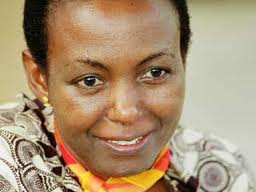
We
quickly remember her humility. As she rose to places of influence she still
listened. She had time to ask questions. In between hurried meetings she was
available.
In
those humble meetings her questions moved to wise guidance. She could master complexities with
grace. Then find a way forward.
We
know her tireless work ethics. This was driven by her deep compassion for women and children. Her compassion spurred on her incredible courage.
The place Minister Inyumba
occupies in our hearts can never be replaced.
Yet by the grace of our Lord the loss and grief we now feel will heal. After all, Minister Inyumba believed in
the hope of our common future. This hope cannot be contained by a created
body of flesh and blood.
The
dialogue I read and heard today was one of memories. I noticed three enduring
legacies of Minister Inyumba.

The first was her
faithfulness. Her name follows the
history of her people. She is found in a multiple of historic
roles. In each role that was given her she was faithful. We were blessed. I can
say with great confidence yesterday, she was met by the Lord with the words, “Well done,
good and faithful servant (Matthew 25:21, 23; Luke 19:17.)”
The second enduring legacy was
her advocacy for women. She healed
our wounds. She served widows. She mentored ceaselessly. She elevated
the status of women by her profound
moral authority. I observed that
her very presence caused us to stop, reflect, and change. Her voice spoke with consistent faithfulness. Her belief
in women’s dignity reflected her faith in God who made all humanity in God’s
image. She saw that God had created
women with unique gifts that must be nurtured. Her advocacy brought us peace and healing.

The last legacy was her
compassion for Rwanda’s children. Her compassion was the authentic compassion
of the Lord. It moved from deep within
her being. It was full of the passion of
humanity. Then it sprang forth in behavior that simply got things done.
One her most enduring quotes is
"We're committed to seeing
all Rwanda's children grow up in loving, caring families and not in
institutions"
A friend
today called her a champion of Rwanda’s
children.
Many of us have personal stories
to tell of Minister Inyumba.
My family shared a similar
conviction with Minister Inyumba that every child has a right to a family. I once had a 10 minute conversation with Minister Inyumba that I could never
forget. She made time for me in busy
day in which she was meeting many important people. We spoke of the de-institutionalization of
orphans and vulnerable children in Rwanda.
She let me see a bit of her
humanity. Why was she facing so much
opposition? Why were there so many untruthful
and unjust accusations?
I shared the nature of
institutions. They are self-protective. It is their nature. Governments protect their tax payers. Churches protect their members. Schools protect their students. Businesses protect their customers.
This is good. In fact such
institutions will endure with generations of good fruit.
However, sometimes an
institution arises that in its self-protection loses sight of the common good. Orphanages easily become these types of
institutions. In order to appeal to
donors they must have children. Keeping
children in institutions is necessary for their survival.
I apologized. My race, nation, and Balokole clan mates
have been some of the worst offenders in institutionalizing vulnerable
children.

I shared a conviction that took
the Lord working on me for 18 years. The
most Biblical way to approach the care of vulnerable children is adoption. In fact, adoption is a metaphor of the
Gospel. Churches that don’t teach and
live adoption are negotiating the Good News of Jesus.
I shared a hope that Rwanda’s
churches and families would arise to meet the challenge. It was my hope that whenever a child fell
into a vulnerable situation a network of families would be prepared by churches
to immediately take that child into their home as a foster child. Hopefully, the child would be reunited with
his extended family. However, if that
did not happen then that child should be adopted and have the full legal and
relationship rights of a biological child.
Minister Inyumba looked
directly into my eyes, accepted my apologies, and then said, “Pastor that is
exactly what I hope also.”
 |
| Gabriel Mugisha Jacobs with the nurses who cared for him in Rwamagana |
God never allows leaders to
simply make proposals and write policy. We must practice what we preach. A few months later, my foster son Gabriel Mugisha Jacobs was having 3
clusters of seizures per day. We had
spent 2 weeks at King Faisal Hospital.
It was time to go to Nairobi.
MIGEPROF and emigration quickly got us the required travel documents. Our family was broke. Then God’s providence happened. Friends in Kenya, Uganda, America, and Rwanda
rallied. Minister Inyumba was one of
the friends who placed a little money in our pockets for Mugisha. Her contribution was one of those first
fruits from which God begin doing the astounding. Mugisha has now not had a seizure in 11
months and is loved by a forever family.
I’m confident Minister Inyumba’s acts of faith are one of the reasons
Mugisha is well.
A
year ago a friend of mine, Major Eustache Nsinga passed from this life. I had the profound responsibility to
perform his funeral. In it I summarized
his life as being irreplaceable. I
believe all of us are created in God’s image and with God’s eternal purpose
given unique gifts. Thus each of us is irreplaceable.
My
sermon was followed by a speech by Rwanda’s
Minister of Defense James Kabarebe who had the courage to point out a hole in
my sermon. We are all in an army
for God. When a soldier falls he must be replaced. Without replacements our endeavors on this
earth are doomed. He was right.
God’s Word fills us with the
wisdom of paradox. Each of us is irreplaceable. Yet, each of us must eventually be replaced.

As
Minister Inyumba is now resting as a rewarded faithful servant it is our task to continue her legacy.
Who will be faithful in whatever
roles one is given?
Who will advance the dignity of
women?
Who will take vulnerable
children into their families to adopt and raise with the full
legal and relationship rights as biological children?
Minister
Inyumba’s passing should cause us to like the men and women of old raise our
hands and say, “Lord, here am I. Send me.”


